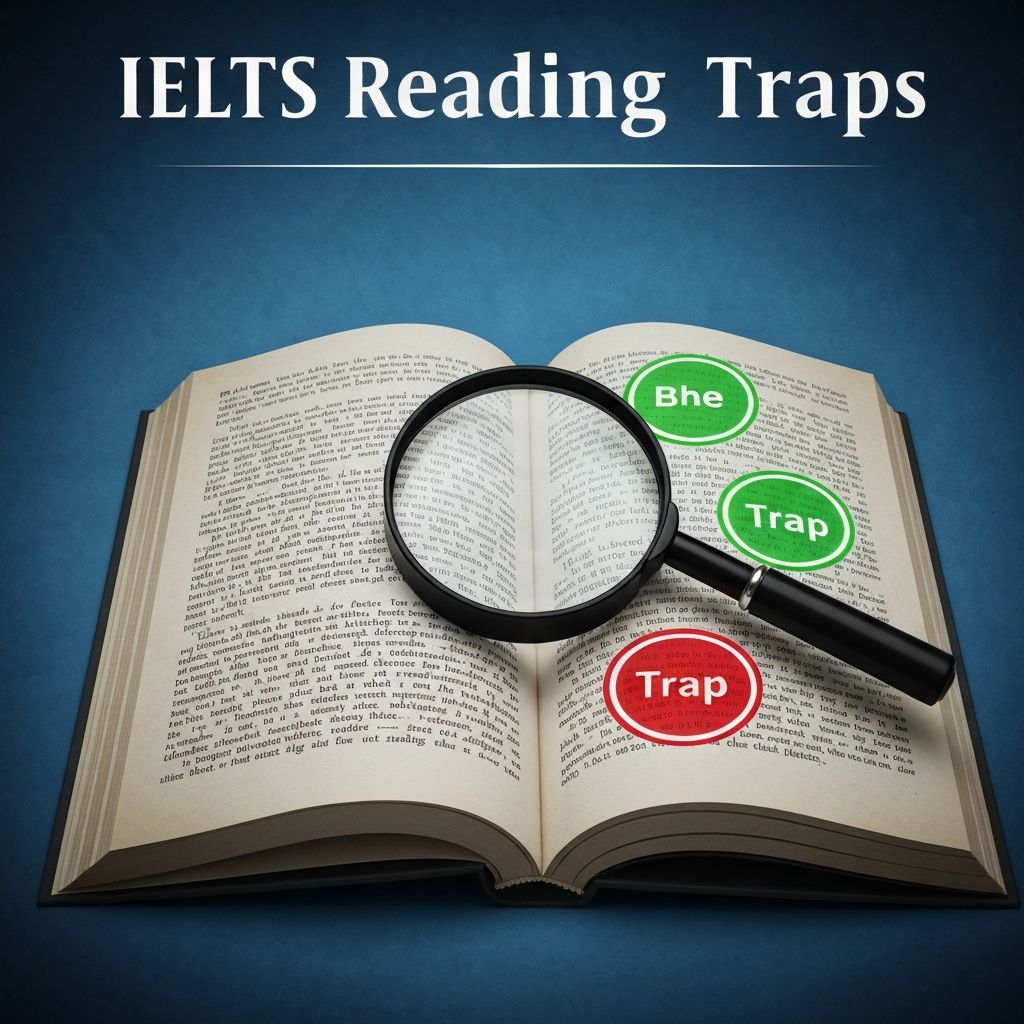
You read the passage carefully. You found the answer. You marked it confidently. Then you checked — and it was wrong. Again. If this sounds like your IELTS Reading experience, you have almost certainly been caught by one of three reading traps that trip up seven in ten test-takers.
The Challenge: Try This Question First
Passage extract: "While the introduction of automated vehicles promises significant reductions in road fatalities, experts caution that widespread adoption remains unlikely before 2035 due to regulatory, infrastructural, and public acceptance barriers."
Question (True / False / Not Given): "Self-driving vehicles will reduce the number of road deaths."
Is the answer True, False, or Not Given?
The 3 Reading Traps
Trap 1: True/False/Not Given — Scope Distortion
The most dangerous reading trap. A statement will be similar to the passage but subtly broader, narrower, or differently conditioned. The passage says "promises significant reductions" — not that it will happen. Learn to match the exact logical scope, not the general topic.
Trap 2: Matching Headings — The Attractive Distractor
Headings questions always include one option that sounds almost perfect but applies to only one sentence in the paragraph, not the main idea. The technique: identify the topic sentence first, then check the rest of the paragraph supports it before choosing a heading.
Trap 3: Sentence Completion — Word Limit Traps
When the instruction says "Write NO MORE THAN TWO WORDS", writing three words gets zero marks even if the meaning is correct. Examiners report this catches approximately 15% of candidates per test. Always count. Always.
The 3-Step Anti-Trap System
- Read the question before the passage — know what you are hunting for.
- Underline the scope words in the question: "always", "all", "the only", "before", "after".
- Match scope, not topic — if the passage says "may" and the question says "will", the answer is False or Not Given.
Practice Makes the Pattern Invisible
These traps become obvious after 20 targeted practice sessions. Our Reading practice tests include T/F/NG sections with detailed explanations for every answer — so you learn the logic, not just the answer.
"IELTS Reading is not a test of comprehension. It is a test of precision."